Updates on the Internet and its social and public policy implications, useful websites, political/cultural musings and more from a UK-based academic, internet consultant and journalist

Archive for the 'Weblogs' Category | back to home

5 March 2012

Of course it has a role for easy, quick communication of relatively unimportant information but I fear that its very availability and ease means that like some kind of online kudzu it is expanding and driving out longer-form online discourse – particularly blogs. This is particularly problematic for academics like myself. It used to be that I would string together 500 words and more about an academic subject or something in the news and post it on my academic blog (okay, I admit I was a grad student with a bit more time on my hands) but now I tend to just tweet or Facebook post about it because the blog form implicitly demands more engagement than I feel I can give. It seems to me that possibly for similar reasons gradually nearly all of the blogs I used to read by fellow academics giving me their insights into trends and papers have died away*, replaced by tweets simply directing me to relevant web addresses.

Don’t get me wrong–I love to read and pass on the kinds of references to papers and to newspaper articles I get–see my twitter feed– but by the time a tweeter tells you who sent them a web address, very briefly summarizes why you might want to click and perhaps provides a hash tag to indicate its subject all that remains to be said is that said document or image is “enjoyable”, “provocative”, scary etc. A blog posting by contrast does not have to be that much longer but allows the writer to provide at least a little more context for the resource that they are talking about or indeed to provide a small but nonetheless useful addition to scholarly knowledge without all the psychic and administrative burden of turning out an academic paper.

Moreover, I have recently realised thanks to the news about Datasift providing companies with access to archives of tweets back to 2010 that although Twitter has kept everything, if I as a user ever did want to find an insightful tweet from even a week ago unless I had favourited it or I had been using third-party programs to archive a particular user or hashtag I would be out of luck. I always supposed that the limitations of search in tools like TweetDeck or Twitter.com itself were just a coding problem not reflective of an underlying technical problem.

* Mind you, this rant which I have been saving for a while now was inspired in part by the excellence of a Nathan Jurgenson blog post which reminded me that academic blog excellence is not yet dead.

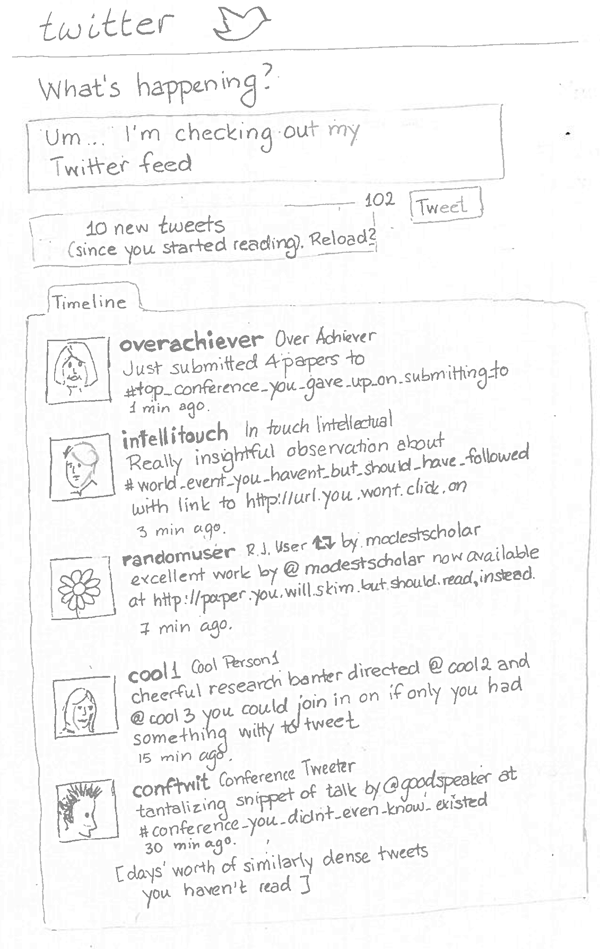
The cartoon below (sorry have lost the original source) presents a number of other good reasons I dislike Twitter…

18 November 2010
Filed under:Weblogs, social media at2:44 pm

Back in 2004 when Technorati, a blog search engine, started to publish information annually about who bloggers were and what they wrote it was gold, because stats were very hard to find. Now that most internet-related surveys include some mention of blogging, however, the deficiencies of Technorati’s work have become more apparent. This year’s “State of the Blogosphere 2010” report was particularly problematic (or have I just started noticing its problems more?)

1) There’s no unified report as a PDF to store away for future reference or print
2) The statistics they quote seem substantially at variance with what other surveys suggest either about blogging in the US (eg from Pew) and UK (eg from OxIS) or about the numbers of bloggers across the world (eg from the World Internet Project or Universal McCann). Interesting if true but the information about how the survey was done is too vague to be useful. It doesn’t say how people were recruited to take part in the survey and across which countries. The proportions they found from different countries are likely to be simply a reflection of the effort they put in to reaching people in those countries and their familiarity with English.

3) This survey is tacitly a survey of the English-speaking blogosphere not the whole blogosphere but is not represented as such throughout so these figures may be cited as reflecting global blogging while they appear to substantially under-count (for example) blogging in China and Japan).

I wouldn’t complain so vigorously or at length except that:
a) once again this shows how US-based internet companies often discuss the internet as if US behaviour could simply be extrapolated to everyone (something I complained about nearly 15 years ago)
b) A survey of this scale if properly done and with data analysed in detail (or even released to the public for download and reanalysis as Pew and OxIS do) could have been genuinely useful.

27 September 2010
Filed under:Academia, Personal, Privacy, Weblogs at11:37 am

I have argued in my thesis (and hope to argue at greater length in book form) that protection of online privacy in practice is not simply a matter of offering the right controls but for users is a complicated balancing of different priorities and values. I would like to chronicle my children’s lives online for a select audience of friends and family but it’s not clear where and how I should do it.

Livejournal offers good privacy controls so I tried using that but I couldn’t get enough of the people I wanted to be able to read it to sign up and remember their passwords and visit.

Facebook now has enough of my desired audience on it to make it worthwhile to publish there and it does allow me to make sophisticated choices about who can read any status update I post, which makes it convenient, but it is also more or less transient (one can read updates well into the past but getting to them is not easy). I would like what I write to remain private but easily accessible and archived.

For me the best security solution so far for pictures and video has been Picasa’s which provides ‘good enough’ security through obscurity (non-search-indexed and un-guessable URLs but doesn’t require visitors to register to view.

What would probably be ideal for me is if there were a blog platform that to enable me to blog semi-securely Picasa-style and more securely (on a post by post basis) to friends who are registered using Facebook Connect or Google Accounts (which most of my would-be viewers have). Any free solutions like that out there?

9 September 2010

Interesting – I just stumbled across a blog post about the demographics of contributors to Global Voices – the source I know best of news and information in blog form from a non-Western perspective. The post reveals among other things that “the Global Voices community is highly educated. Over 85% of respondents indicated they have completed a university degree, and more than 40% have a post-graduate or doctoral degree.” This does suggest alas that while groups like Global Voices have a valuable role to play in making voices heard that might not otherwise have a platform, blogging to and for a wider public still remains an elite activity.

13 July 2010

I am working on a presentation for IAMCR 2010 about the need to adjust media literacy education to encompass new forms of online practice and I would value your help, fellow netizens and academics. I am looking for references to the potential benefits that can be derived by individuals from their social media use. So far I have come up with the following categories and key texts:

  • Building and maintaining social capital (Steinfield, C., Ellison, N., & Lampe, C. (2008). Social capital, self-esteem, and use of online social network sites:A longitudinal analysis. Journal of Applied Developmental Psychology, 29(6), 434-445.)
  • Finding one’s voice politically (Rodríguez, C. (2001). Fissures in the mediascape: an international study of citizens’ media. Cresskill, N.J.: Hampton Press.) (maybe also Couldry’s new “Why Voice Matters”? though I have not had the chance to read it yet)
  • Finding one’s voice culturally/creatively
  • Having a space to reflect on one’s self-identity (Stern, S. (2008). Producing Sites, Exploring Identities: Youth Online Authorship. In D. Buckingham (Ed.), Youth, Identity, and Digital Media (Vol. -, pp. 95-117). Chicago.
  • Having the opportunity to reflect critically on media products through increased familiarity with media forms Jenkins, H. (2006). Confronting the Challenges of Participatory Culture: Media Education for the 21st Century.
  • Learning employment-related content creation skills

Are there any important categories I have missed? And what are the best empirical and theoretical references you would suggest that could relate to each of these themes?

I’ll add a link to my presentation here as soon as I upload it after the conference.

29 June 2009
Filed under:Best of blog.org, Personal, Weblogs at9:24 pm

For those of you not following me on Facebook or on twitter (drbrake) I submitted my doctoral thesis back in April and today it was formally examined. I was asked to provide some minor revisions and once I have done so (within the next three months) I will officially become Dr Brake (or Dr D.R. Brake if you like as my forenames are David and Russell). For more on my thesis (which I will also make available online once I have done the revisions) visit my academic publications page.

23 October 2008

You may have my main blog feed in your RSS readers but did you realise that I am now producing seven RSS feeds? (plus a stream of status updates which are hopefully only available to friends on facebook, twitter and jaiku).

Most of the feeds are linked from this blog somewhere – the exceptions being the feed for my academic group weblog and that for my lastfm listening. But if you want all of my public media consumption and both micro and macro-publishing, go to http://friendfeed.com/davidbrake/ and get the One True Feed…

10 September 2007

Perhaps it is the novelty value, perhaps it is the sense that on Facebook I am addressing friends while on this blog I am mostly addressing people I don’t know but the impulse that would once have sent me off here to post little observations on everyday life and news items seems to be being increasingly fulfilled by status updates and the occasional wall posting over there.

When I started blogging I didn’t really think about who my readers might be. When I did start thinking it might be useful to be able to mix private matters with public ones there wasn’t much available except LiveJournal that would give me that kind of control and I quickly discovered that most of my friends are casual enough Internet users not to bother setting up an LJ identity in order to be able to keep up with me and my doings. But Facebook seems to be drawing in a wide enough net that what I write feels like it is going to a substantial number of the people I want to be reaching. Even my brother is on it (though naturally enough my father isn’t there… yet…) and my father, not wishing to be left out, has just joined!

25 June 2007

As Fuhnie observes, the band Sprites have come up with what sounds to me like the ideal blogger anthem ‘I Started A Blog Which Nobody Read’, which starts:

“I started a blog, which nobody read
When I went to work I blogged there instead
I started a blog, which nobody viewed
It might be in cache, the topics include:

George Bush is an evil moron
What’s the story with revolving doors?
I’m in love with a girl who doesn’t know I exist
Nobody hates preppies anymore…”

It’s well worth a listen – you can hear the song while watching this (rather poor) fan-made video:

I am surprised there aren’t more songs about blogs or about social network software – or am I just not aware of them? Comment with any entertaining ones you have found…

17 February 2007
Filed under:Online media, Weblogs at7:57 pm

365 Ways to Change the World – stocked by the cash register of my local bookstore – includes “Fight child slavery with fairtrade chocolate” alongside, “Influence the world’s media: become a blogger”. Unless you happen to live in a country or situation that is both inaccessible and newsworthy or you have specialist expertise and connections to the mainstream media you are unlikely to make much of an impact on the mainstream media, and in any case there are many reasons to blog and a desire to influence the world’s media is one of the least common.

Next Page ?