Updates on the Internet and its social and public policy implications, useful websites, political/cultural musings and more from a UK-based academic, internet consultant and journalist

Archive for the 'problems with technology' Category | back to home

28 March 2013

Like many a tech-savvy parent I am trying to divert my kid’s gaming attention towards Minecraft – and with some success. There’s a ‘legacy’ iBook G4 he can use but getting the program to run at all was difficult and now that it is running, I have found it runs unusably slowly, even with all the graphical options I could find turned down (and with non-working sound). This to run a game that is deliberately designed to look ‘retro’ and which I imagine could have worked on a Mac LC c. 1990 if suitably coded! Since it’s a very popular game with a hyperactive development community I thought there was bound to be a way to make things work better. Alas, nothing I tried (Magic Launcher launching Optifine Light mainly) seemed to work and it took me several hours of forum reading, installation and tweaking to get this far.

It’s not a new observation but what makes older machines like my nine-year-old macbook obsolete does not actually seem to be the speed or capability of the underlying hardware but the steady ratcheting up of the assumptions that software makes. Somewhere (presumably in Java, which is Minecraft’s ‘environment’) I’m guessing there’s a whole load of un-necessary code that has been added in the last nine years which has dragged what should be a perfectly usable game down to a useless speed.

Just to drag this back to academic relevance for a moment, this is to my mind a good example of how the structure of the computer industry aggravates digital divides by gradually demanding users ‘upgrade’ their software to the point that their machines stop working, well before the end of their ‘natural’ lives.

PS If anyone has managed to get Minecraft working adequately on a Mac of similar vintage please share any tips…

12 December 2012

Picture from Jeremy Selwyn via The Evening Standard

I set out last night on a five-mile cycle journey to meet a friend which turned into an hour and a half odyssey thanks to freezing fog but also technological dependency. It was late in the day so my Galaxy Nexus was already low on charge but I thought had enough to use to navigate. Intermittent use of the GPS was enough to make it go flat but not enough to help me to navigate successfully. I then realised without my phone I didn’t even have a map. I would have called my friend to tell him I was running late but of course my phone didn’t work and because “everyone has mobiles these days” the few remaining phone booths on my journey didn’t work. For a moment I thought of working out my laptop from my bag and Skyping my friend but, of course, my mobile broadband is dependent on (you guessed it) my phone.

Fortunately, I did manage to get to him in time to see Argo together (very good) but our dinner was extremely brief (sorry John!). On the upside cycling around the back streets of Hampstead in the fog was extremely atmospheric. I’d show you some pictures but I don’t carry a camera any more because I have one always with me… in my phone!

6 August 2012

Evgeny Morozov has recently delivered a scathing (and funny) dissection of a collection of TED ebooks, including most prominently one by Parag and Ayesha Khanna. Leaving aside the superficiality of the ideas he mocks (I have not read the works in question) he points out something rather more disturbing in their work – the anti-democratic streak that appears to run through it eg:

We cannot be afraid of technocracy when the alternative is the futile populism of Argentines, Hungarians, and Thais masquerading as democracy. It is precisely these nonfunctional democracies that are prime candidates to be superseded by better-designed technocracies—likely delivering more benefits to their citizens…. To the extent that China provides guidance for governance that Western democracies don’t, it is in having “technocrats with term limits.

It gets worse though – after the publication of Morozov’s critique, Vishrut Arya found an interview with Ayesha wherein she reflects (from around 2:00 on) on the exciting possibilities that augmented reality glasses would enable people who didn’t like homeless people to simply delete them from their sight. When I read this I assumed it was meant by her as some kind of warning but on listening she follows this with “…so now we have enhanced our basic sense”.

I am not surprised to find TED giving credibility to this kind of pundit – I am, however, disturbed and disappointed to see that my alma mater, the LSE, giving her a platform by making her director of their Future Cities Group (while she finishes her PhD there). Seems like another potential Said Ghaddafi embarrassment in the making. Certainly Beatrice and Sidney Webb would be turning in their graves!

5 March 2012

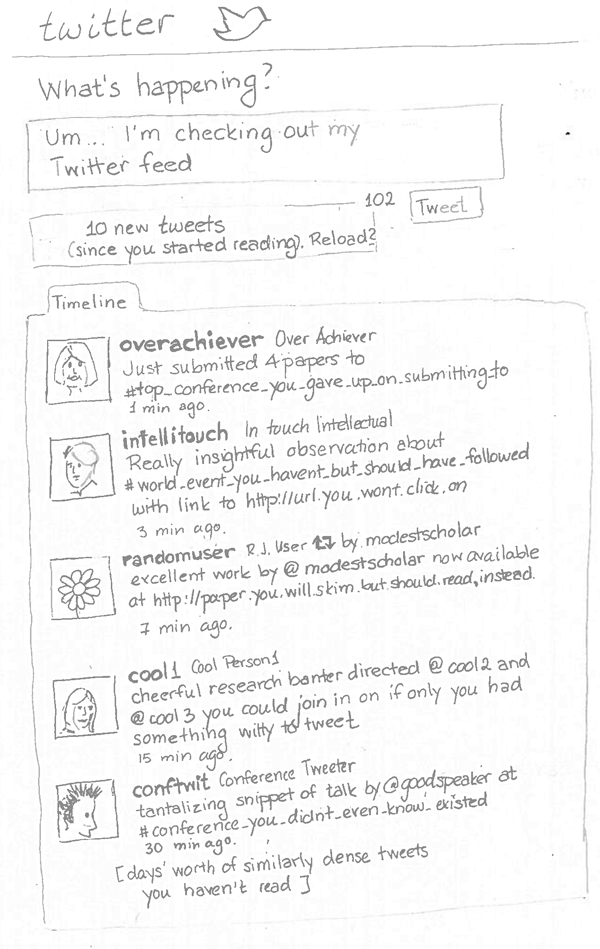
Of course it has a role for easy, quick communication of relatively unimportant information but I fear that its very availability and ease means that like some kind of online kudzu it is expanding and driving out longer-form online discourse – particularly blogs. This is particularly problematic for academics like myself. It used to be that I would string together 500 words and more about an academic subject or something in the news and post it on my academic blog (okay, I admit I was a grad student with a bit more time on my hands) but now I tend to just tweet or Facebook post about it because the blog form implicitly demands more engagement than I feel I can give. It seems to me that possibly for similar reasons gradually nearly all of the blogs I used to read by fellow academics giving me their insights into trends and papers have died away*, replaced by tweets simply directing me to relevant web addresses.

Don’t get me wrong–I love to read and pass on the kinds of references to papers and to newspaper articles I get–see my twitter feed– but by the time a tweeter tells you who sent them a web address, very briefly summarizes why you might want to click and perhaps provides a hash tag to indicate its subject all that remains to be said is that said document or image is “enjoyable”, “provocative”, scary etc. A blog posting by contrast does not have to be that much longer but allows the writer to provide at least a little more context for the resource that they are talking about or indeed to provide a small but nonetheless useful addition to scholarly knowledge without all the psychic and administrative burden of turning out an academic paper.

Moreover, I have recently realised thanks to the news about Datasift providing companies with access to archives of tweets back to 2010 that although Twitter has kept everything, if I as a user ever did want to find an insightful tweet from even a week ago unless I had favourited it or I had been using third-party programs to archive a particular user or hashtag I would be out of luck. I always supposed that the limitations of search in tools like TweetDeck or Twitter.com itself were just a coding problem not reflective of an underlying technical problem.

* Mind you, this rant which I have been saving for a while now was inspired in part by the excellence of a Nathan Jurgenson blog post which reminded me that academic blog excellence is not yet dead.

The cartoon below (sorry have lost the original source) presents a number of other good reasons I dislike Twitter…

4 February 2011

1) I started my new job as Senior Lecturer in the Division of Journalism and Communication at the University of Bedfordshire this week and have enjoyed meeting my new colleagues (and collecting my new Macbook Pro).
2) I just met my editor at Palgrave and agreed to write a book (my first full-length academic one) provisionally titled “Sharing Our Lives Online: Risks and Exposure in Social Media” – likely to be delivered in 2013. I plan to blog about it as I write using the “Sharing Our Lives Online” category, so keep an eye on that…
3) On my way back from that meeting I discovered that my wife has also just found a position for when her current one finishes, which given the turbulent situation in the NHS where she works is a big relief.

Of course I would be open to receiving further good news but these three bits of news are certainly enough to be starting with!

19 October 2010

Trust-e, a private organization which promotes and monitors internet industry self-regulation, has produced a survey of US teens, social networks and privacy it entitled The Kids Are Alright. As its title suggests, its conclusions are broadly soothing. Facebook posted a status update about the report saying that it found “the majority of parents and teens understand how to protect their privacy and think their controls on Facebook are easy to use.” This is not true – it found that the majority of parents and teens believe or state that they understand how to protect their privacy. But as Sonia Livingstone’s work with teens and parents found (for example), teens may have difficulty understanding privacy settings without realising it and parents may underestimate the degree of risk their children encounter.

The trust-e survey did find that 18% of teens, “have been embarrassed or disciplined as a result of a posting”. 48% of parents and 41% of teens also did not agree that Facebook’s privacy settings are clear and easy to use, and the fact that 21% of teens never worry about their privacy when using Facebook should be a cause of concern not celebration. Other stats of note:
10% of parents admitted to secretly logging into their teens’ FB accounts to monitor their use.
10% of teens post things they would not want parents or teachers to see frequently or all the time
8% of teens accept all friend requests

13 October 2010

Alas I have not yet got a copy of Kevin Kelly’s latest book. I am looking forward to seeing it but not perhaps for reasons he would appreciate. Cory Doctorow says that Kevin Kelly suggests in his new book “humans cannot direct or prevent technology’s course, at least not in the long run”. If this is an accurate summary, then a) it makes a mockery of the subtitle of his book “how technology changes us and vice-versa” (emphasis mine) and b) it makes me want to get ahold of the book and maybe add it to a future course just in order to provide evidence that popular and well-respected thinkers take this point of view, which has been widely criticised in academic circles. In fact “technological determinist” is something of a dirty word (phrase?) in academic discourse. That’s not to say that technologies don’t have their own logics in my view, but they are expressed in different ways in different societies. Mind you I find the opposite, hard social constructivist line controversially laid out by Grint and Woolgar in, for example, “What’s Social about Being Shot?” is equally unpersuasive.

Here’s a brief example of why KK is wrong – why have we taken so long to put wheels on suitcases? Not because the technology to do so did not exist, nor because it would not have been useful. I wager it’s because it took the disappearance of servants and the increase in all forms of travel to make the difficulties in lugging around luggage socially important enough to make people start thinking of alternatives.

If you don’t want to buy “What Technology Wants”, there’s a blog posting by KK that seems to cover this part of his argument here.

via a review of the book by Cory Doctorow at BoingBoing

8 September 2010

There has been much concern about people selecting only news and information they already know they are interested in and that agrees with their point of view via the internet. I have found that increasingly the “omnivore” blog from bookforum.com has been fulfilling that role for me, bringing me articles every week on the future of books, of journalism or of academia. Unfortunately, I am starting to suffer from punditry fatigue. Read too much on the same subject from newspapers and magazines – even if the subject is important to you – and it all starts to blur together after a while. In truth, it shows up the problems even with good journalism as compared to academic work. There is copious opinion but often little reference or only selective reference to new data or even to new arguments or approaches to the issues. Yet I feel I still need to read or at least skim it all in case I miss some new piece of information. Perhaps I would be better off just relying on the stuff that my peers circulate via the blogosphere and twittersphere?

29 June 2009

I replaced my five year old PowerPC-based iBook G4 with a practically identical MacBook last week and I know at least one other reader is contemplating the same thing so here are some impressions and a few problems/requests for help.

Good:

  • As you might expect, I got more storage – 500Gb instead of 80 – which means I can now have all my music and all my pictures and all my movies on one machine instead of having them distributed on different ones.
  • My battery life has gone back up from c. 1hr to supposedly nearly five (as yet untested).
  • Having a built in webcam is pretty entertaining.
  • Making the transition was very easy even though it involved a change of processor architecture as well as a change of machine. Only a few applications broke and almost all the application settings remained intact. I was working on the new machine within a half day of connecting it to the old one.
  • Thanks to a “back to school” offer the new macbook came with a (nearly) free iPod Touch which was significantly better than the first generation one I had in that it includes a volume control and can accept a microphone.

Bad:

  • The down arrow already seems to be coming loose though the machine has not been subjected to any physical stress I can think of.
  • Even with nearly double the RAM (2Gb) and I would have thought several times the raw processing power, the new machine feels very little faster. Moore’s law suggests I should see a 4x speed increase – where is it? One can’t blame The Great Moore’s Law Compensator – the tendency for software to get more and more bloated as processors improve – because I am running the same software I was last week. Are there a lot of non-native applications still on my machine running in emulation? Will I see a dramatic boost if I “top up” to 4Gb of RAM?
  • It’s not noticeably lighter either though I believe it is supposed to be slightly lighter and it is just different enough in shape that I had to buy a new case for it.

Help, please?

  • Adobe AIR seems not to work despite uninstalling and reinstalling it twice so BBC iPlayer and Tweetdeck don’t work either. Any ideas?
  • I installed Windows 7 RC via Bootcamp but none of the games I have installed to date via Steam run – in the case of TF2 I get the “splash screen” and the icon briefly appears in the dock but then it disappears without even an error message. Should I try installing parallels, fusion or one of the other multiple-OS enabling apps and try that? Any other ideas?
  • Any ideas about how I can get my Macbook to recognise the existence of an external monitor when it is running Windows 7? If I do get it to play games I would prefer to play them on my 19″ monitor.
9 March 2009

By way of background, I have been thinking seriously about switching to Freesat (our house can’t receive Freeview). In addition our DVD recorder appears to be dying, and our TV set is at least 22 years old so it surely has to die soon, which would mean going HD. Knowing that HD is the future it seems silly to buy a new device that only played and recorded at standard definition. So logically a box which offers Blu-ray recording and built-in Freesat recording would be a sensible purchase, since both functions would be useful now or in the future. Imagine my delight when I heard that just such a device was about to arrive here – the Panasonic DMR-BS850. So what would I expect to pay for that? Well the Humax Freesat DVR is £300 and a Panasonic Blu-Ray player starts at £180 or so. I’d expect to pay another £100 or so to be able to record onto Blu-Ray as well but I’d also expect a little cost saving for buying everything in a single box. So maybe they’ll charge £550? Nope – it seems Panasonic plans to charge nearly double that sum for their new gadget. Bah!

I guess what I’ll do is buy a Humax box, possibly a cheap replacement DVD recorder (£130) when this one flakes out and wait for my TV to die and for Blu Ray pricing to become rational…

Next Page ?