Weblog on the Internet and public policy, journalism, virtual community, and more from David Brake, a Canadian academic, consultant and journalist

Archive for the 'Positive uses of technology' Category | back to home

2 November 2003

What a good idea from “Tom Steinberg”:http://www.tomsteinberg.co.uk/ – mySociety.org. His recent “piece in the Guardian”:http://www.guardian.co.uk/online/chatroom/story/0,12529,1073754,00.html explains the idea better than I could, but basically the idea is to provide a way for private funders to pay for inexpensive but useful websites that are not commercial but which the UK government doesn’t feel it is able or willing to produce.

There are already a few interesting ideas on the site including mobile phone-based “car sharing”:http://mysociety.blogs.com/mysociety/2003/10/mobile_phone_lo.html and websites to facilitate “local swapping of power tools, lawn mowers etc”:http://mysociety.blogs.com/mysociety/2003/10/local_swap_shop.html I hope it will go on to be the start of something big.

Already he has something which other sites of this kind usually don’t – he has some money he can offer to kick-start these projects. It’s only £10,000 so far but it’s enough to get people to put in bids…

(Title for this posting was shamelessly pinched from “Tom Loosemore”:http://www.tomski.com/)

26 October 2003

Some very useful-looking web tools to help UK citizens to hold their national representatives (MPs) to account and to organize offline and online campaigns for change. Public Whip takes publicly available information about all Westminister MPs and brings it together in an easy-to-view manner. You can see how often your MP votes, how often they vote with their party and, most importantly, how they voted on specific issues.

“iCan”:http://www.bbc.co.uk/dna/ican/ from the BBC is a long-awaited site (still in beta) designed to enable and encourage community activism. It includes advice from activists, tools to link grassroots campaigns to larger organizations, and roving reporters who will publicise success stories. If it is done right this could be big (but if it is too successful it could involve the BBC in some interesting rows!). One interesting thing I notice already – I don’t know yet whether this is crucial or a weakness – is that to register you are encouraged to give your real name. For most online communities this would be an advantage, but if I were starting a campaign on something controversial I might not want to do so in a way that could allow employers to identify me. Of course, there’s nothing in the BBC’s registration process to prevent you from lying…

Thanks to “NTK”:http://www.ntk.net/2003/10/10/ for the links.

20 October 2003

intro is an application for conference-goers designed to help them meet others who share their interests and attitudes (I apologize in advance for the over-Flash-y website – what do you expect from a Macromedia-led project?). I have dreamed for years of something like this, but it won’t realise its true power until you can essentially download it into your location-aware PDA/smartphone.

17 October 2003

Ever wanted to get several people coordinated across the world using a calendar? Microsoft Exchange lets you do this easily across the web (and has other useful features like the ability to automatically schedule events) but of course it costs money and using Outlook does make you more vulnerable to viruses. There are a couple of free solutions available, each with benefits and drawbacks. Of these the best two I have found are Localendar which looks slick and (if you are in the US) includes an interesting “see public events near you” feature. You can also add features like import/export to Palm or Outlook or a message board if you pay.

“Calendars.net”:http://www.calendars.net/ would be my choice. It looks very powerful – it lets you edit calendars offline (and sync with Palm or Outlook) using a separate Windows application – “iCal”:http://www.brownbearsw.com/ical/newical.htm – then upload them, and allows multiple security levels (so you can set certain groups with the ability to view, others who can post new events etc). It also supports email notification for events and works in different languages. The drawback is that it looks as if it might be somewhat complicated to get to grips with as a calendar administrator.

The only thing none of these calendars seem to do is allow you to automatically enter pre-set locations (meeting rooms etc) and schedule them or auto-schedule people if you know what their schedules look like. If anyone knows any free web-based software that does this I would be interested to hear about it!

15 October 2003

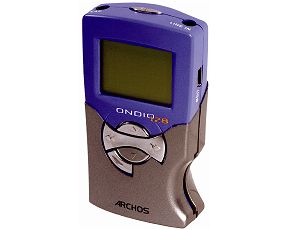
Ondio
I wanted a USB data storage device, but it seemed a shame to get one that just did data storage. So I ended up with the Archos Ondio which has 128Mb of storage (but is expandable through MultimediaCards – yet another new storage format to deal with). But that’s not all…
* it’s also an MP3 player
* And has an FM radio…
* But (unlike most other similar players) you can record from the built in radio.
* And it is a voice recorder…
* But (unlike most other similar players) it also has a line-in jack so you can record streamed audio (or any other audio source like tape) directly into the device for later playback.
* And if you send it plain text files you can even read them on the built-in 112×64 pixel screen!
I am also happy that it works on AAA batteries instead of requiring a special charger.

Truly this is a Swiss army knife among USB storage devices!

Minor drawbacks I have come across so far
* I had some teething troubles getting the USB to connect to my home Win2k PC (but it worked trouble-free when connected to two other win2k computers, and the tech support guy I reached was pretty good)
* It did once cause a fatal system crash for no discernable reason when re-attached to a Win98 laptop.
* I can copy MP3 files over to it directly without trouble but the Musicmatch Jukebox software playlist copying doesn’t seem to function – I’ll be nagging tech support about that tomorrow.
* The radio doesn’t pull in the signal terribly well (it’s probably the last analogue radio I’ll buy!)
* The UI is a little clunky (perhaps not surprising since it is so small and has just 5 buttons to work with)
* It’s the size of a (small) mobile phone instead of being thumb-sized, but I’ve got reasonably big pockets.
* To connect it to USB you need to carry around a USB cable – it won’t plug in directly.

I’ve only had it for an afternoon so I may become more disillusioned later.

FWIW I bought it in the UK from Datamind for £120 inc VAT – the cheapest price I was able to find. I’m not amused to note it is $150 direct from Archos, but I thought having a UK supplier was worth a few quid.

P.S. Before you ask, I did consider buying a hard disk-type device instead but
1) The prices are still too high (around double?)
2) They are significantly larger/heavier and not solid state like this is.
3) I don’t think I really need that much portable storage at present and when I decide I do I can buy a storage card for it (and other things like cameras) once prices for those drop further.
4) The iPod doesn’t record or include a radio – what’s up with that?

6 October 2003

David Docherty may be self-serving in this Guardian article plugging “YooPublica”:http://www.yoomedia.com/Public_Sector.html his commercial public sector digital TV initiative, but that doesn’t mean his idea is wrong. He suggests that the people at the bottom of the ladder who will be the last to switch to digital TV should get Government-sponsored set top boxes that also deliver government services – essentially a return to the “business model” of Minitel, which became a widespread interactive service in France because it was subsidised by the government to replace the phone book (not that it did, but that’s another story).

Back in November I suggested that something like this would “be a good idea”:https://blog.org/archives/cat_egovernment.html#000540 and if I hadn’t been busy on other things I always meant to write something for a think tank suggesting it. Glad to see someone else out there had a similar idea and is trying to make it happen.

18 September 2003

I “never thought it would happen”:https://blog.org/archives/cat_online_media.html#000861, but here’s a major media organization that is going to produce and promote its own peer to peer application. The BBC’s new media director Ashley Highfield just revealed plans to produce, “a fully flexible, platform-neutral, super EPG… that will allow TV content to be recorded TiVo-style.” I’m guessing that it won’t be designed to allow general p2p file sharing – only sharing of BBC content. It’s a little unclear at present whether we’re talking about a set-top box application or something for PCs or both. I hope more detail will emerge soon…

I’m even more delighted that the BBC is going to try to produce ‘ultra-local TV news’ accessable via iTV. I hope this move will not be led merely by the local radio stations but will also give a variety of local groups access to the media.

Thanks to “Techdirt”:http://techdirt.com/articles/20030918/068232.shtml for the link

15 September 2003

When I “posted earlier”:https://blog.org/archives/cat_online_media.html#000877 about The New Standard I forgot to mention another interesting example of alternative media different both from the IndyMedia and The New Standard styles. OhMyNews, a newspaper from South Korea, has thousands of “citizen reporters”. These get paid and go through the conventional editorial process but the pay is less than for conventional journalism and no credentials are necessary. This would seem to allow for the kind of “native reporting” (reporting by “ordinary people” and those directly involved in news events) that Chris Atton and others find a particularly appealling function of the new alternative media while preserving some of the quality standards that ensure good material is read and bad material hidden or discarded.

Significantly, OhMyNews seems to be successful as a business and a social phenomenon, though this may be in part simply because South Korea is one of the most wired countries in the world.

10 September 2003

The “Internet Archive”:http://www.archive.org/ which has an index of 11bn web pages – snapshots of the web at various stages of its development – now has a “search engine”:http://www.archive.org/iathreads/post-view.php?id=8569 covering at least part of the archive. So you don’t need to know the precise address of the web page you had given up for lost (though that function still works). And you can see how the web saw things over time – you can see when a topic became “hot” for example – it provides supplementary graphs.

Thanks to “BoingBoing”:http://boingboing.net/2003_09_01_archive.html#106280030381534395 for the link

26 August 2003

There seems to be a gulf between what the BBC reported its head to have said and what a transcript of the speech revealed. There has been some excited discussion by Danny O’Brien and Alan Connor (and, inevitably, on Slashdot and kuro5hin) that seem based on what they would like this announcement to be rather than what it is.

Matt Jones (who works at the BBC) says the move is, “brave and disruptive – and will have to be executed as such, with no half-measures or compromises to vested interests.”

In fact, while BBC News’ summary suggests Dyke said the Creative Archive would contain “all the corporation’s programme archives”, the speech actually promised to allow “parts of our programmes, where we own the rights, to be available to anyone in the UK to download” (emphasis mine). Nothing there about all of the BBC’s archives. And the example he uses – kids downloading, “real moving pictures which would turn their project into an exciting multi-media presentation” make it sound like a collection of digital clip-art.
(more…)

? Previous PageNext Page ?